Key Specifications
 Prime Delivery • 30-Day Returns
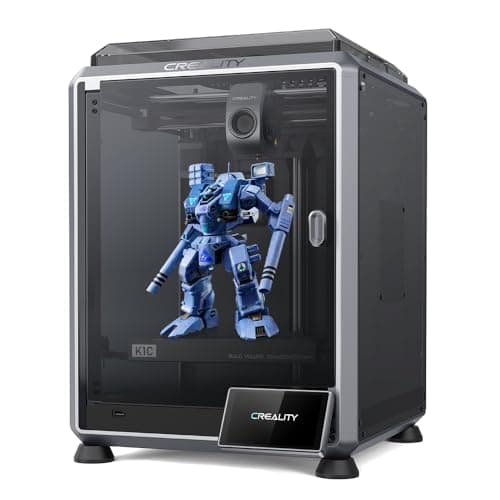
Creality K1C 3D Printer, 2024 New Version 3D Printers with 600mm/s Fast Printing Speed, Support Carbon Fiber Filament 300℃ High-Temp Print, Auto Leveling and Clog-Free Direct Extruder
The Creality K1C is a modern FDM-type 3D printer designed for speed, versatility, and convenience. It uses a CoreXY motion system, a direct-drive extruder built for reliable filament feeding, and supports a wide range of materials (PLA, PETG, ABS, TPU, carbon-fiber–filled filaments, etc.) thanks to its hotend that can reach up to 300 °C.
Key Features
The Creality K1C is a modern FDM-type 3D printer designed for speed, versatility, and convenience. It uses a CoreXY motion system, a direct-drive extruder built for reliable filament feeding, and supports a wide range of materials (PLA, PETG, ABS, TPU, carbon-fiber–filled filaments, etc.) thanks to its hotend that can reach up to 300 °C.
Available Colors
Key Considerations
Print speed vs. quality tradeoff — The K1C supports very high speeds (up to 600 mm/s), but printing that fast may require careful tuning and may sacrifice some print detail or surface quality.
Material compatibility & hotend temperature — With a 300 °C hotend and a robust direct-drive extruder, the K1C supports a broad range of filaments, including abrasive or composite filaments (carbon fiber, etc.).
Build volume limitations — The 220×220×250 mm volume is decent for many uses, but may be limiting if you want to print very large objects or multiple large parts at once.
User-friendliness & automation features — Auto-bed leveling, runout detection, clot-free extruder design, and AI-enabled monitoring add convenience and reduce chances of print failure.
Reliability & maintenance — While the printer’s design strives for reliability (clog-free extruder, sturdy build), some users report issues (see below). It’s worth considering your tolerance for occasional troubleshooting or maintenance.
The K1C utilizes a CoreXY motion system, which allows the printer to reach very high print speeds — up to 600 mm/s with acceleration up to 20,000 mm/s². This makes the printer appealing for users who want fast turnaround, especially if printing many parts or iterating quickly. However — as with many high-speed printers — maintaining print quality while printing fast often requires tuning (layer height, cooling, slicer settings). According to reviewers, for best results many users settle around more moderate speeds (~250–300 mm/s) for a balance between speed and quality.
These factors represent the most critical aspects that will impact your satisfaction with this product.
Customer Reviews
I was really surprised at what this printer can do. I have 5 of them now and use them for production parts in my valve and machine. I even print sprockets using a chain drive and PC carbon fiber PETG carbon fiber.
I am very impressed by my first 3D printer - I got it for prototyping cast metal parts, and I knew it would be a rabbit hole of learning a whole new technology. But this printer has made it fun rather than difficult. Assembly took less than an hour, and within 24 hours, I had my first finished prototype, using bronze PLA. It's been running almost constantly in the 2 months I've had it.