Key Specifications
 Prime Delivery • 30-Day Returns
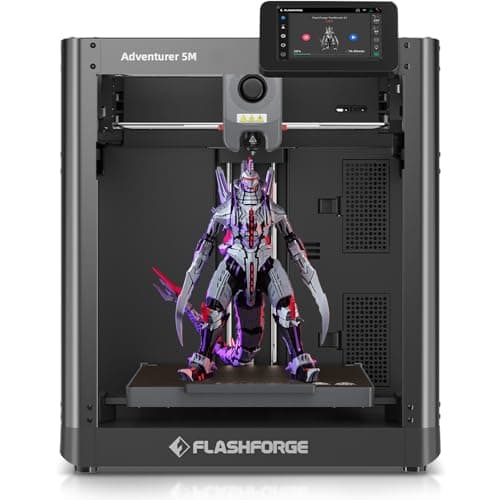
FLASHFORGE Adventurer 5M 3D Printer with Fully Auto Leveling System, Max 600mm/s High-Speed, 280℃ Quick-Detach Nozzle, CoreXY Structure for Superior Print Quality, Rookies & Experts Smart Choice
The Adventurer is marketed as a “starter-to-mid-range” 3D printer — combining convenience for beginners with useful features for hobbyists or small-scale printing tasks. It’s designed to be relatively plug-and-play: you don’t need deep technical expertise to start — yet it offers enough flexibility (heated bed, filament support, removable build plate, multiple connectivity options) for varied everyday printing projects such as prototypes, small functional parts, decorative items, or educational/hobby prints.
Key Features
The Adventurer is marketed as a “starter-to-mid-range” 3D printer — combining convenience for beginners with useful features for hobbyists or small-scale printing tasks. It’s designed to be relatively plug-and-play: you don’t need deep technical expertise to start — yet it offers enough flexibility (heated bed, filament support, removable build plate, multiple connectivity options) for varied everyday printing projects such as prototypes, small functional parts, decorative items, or educational/hobby prints.
Key Considerations
Your Printing Needs & Size of Prints: The build volume (~220 × 220 × 220 mm) is decent for many small-to-medium projects but may be limiting if you intend to print very large objects.
Material Compatibility & Intended Filaments: The printer supports common filaments (PLA, PETG, TPU), and — depending on nozzle/bed setup — it may handle more demanding materials; but for advanced engineering plastics you may face limitations.
Ease of Use vs. Customization: Adventurer tends toward user-friendliness (detachable nozzle, flexible bed, filament sensor/runout detection, removable build plate), which is ideal for beginners. But that may come at the cost of advanced customization or printing of complex materials.
Quality vs. Speed vs. Simplicity: For simple prints, convenience may outweigh top-tier print speed or ultra-high resolution. If you need very precise, technical prints or want to push limits (exotic filaments, large-scale, high-detail), you might need a more advanced or specialized printer.
Reliability & Maintenance: Features such as heatable bed, flexible build plate, removable nozzle help — but like any FDM printer, long-term reliability depends on correct maintenance (bed leveling, filament quality, nozzle cleaning).
Supporting common materials such as PLA, PETG, and TPU ensures that users can create functional, decorative, or flexible objects. These materials are affordable, easy to print, and widely used in educational or hobby environments.A stable frame, consistent motion system, and controlled temperature environment contribute to reliable print results. For beginners, reliability is more important than extreme precision because it builds confidence and reduces failed prints.
These factors represent the most critical aspects that will impact your satisfaction with this product.
Customer Reviews
The Adventurer 5M has been an absolute workhorse. It puts out consistent, reliable prints day after day with almost no downtime. I waited until I had real hours on this machine before reviewing it,
This was simple to set up right out of the box. Bed leveling was simple, the glue that is provided is very good. The accuracy in printing this does is amazing and a great value for your money. Functionality I was worried about because we were giving this as a gift for our 10 yr old son but he is able to use it without issue and so is his 8 yr old brother.