Key Specifications
 Prime Delivery • 30-Day Returns
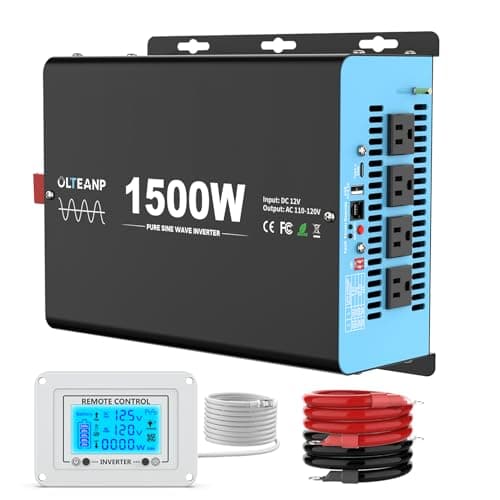
OLTEANP New Upgraded 1500 Watts Pure Sine Wave Inverter, 12V DC to 110V AC Power Inverter with 4 AC Outlets, USB Port, Type-C Port for Truck, Vehicle, Power Outage, Remote Control with LCD Screen
This is a DC-to-AC power inverter that converts 12 V DC (from a battery or vehicle) into standard 110 V AC — effectively letting you run household-type appliances and electronics from a battery source. It’s designed for cars, RVs, trucks, boats, or off-grid / backup power systems. The inverter provides up to 1500 W continuous output, with a peak/surge capacity around 3000 W, which helps start devices that need a heavy burst at startup.
Key Features
This is a DC-to-AC power inverter that converts 12 V DC (from a battery or vehicle) into standard 110 V AC — effectively letting you run household-type appliances and electronics from a battery source. It’s designed for cars, RVs, trucks, boats, or off-grid / backup power systems. The inverter provides up to 1500 W continuous output, with a peak/surge capacity around 3000 W, which helps start devices that need a heavy burst at startup.
Key Considerations
Total power draw of devices — make sure that the combined wattage of devices plugged in at once does not exceed ~1500 W continuous (surge load up to ~3000 W).
Battery capacity and type — since the inverter draws DC power, the battery must supply enough current, and for extended use a sufficiently large battery (or deep-cycle battery) may be needed.
Wiring & connection quality — for safe operation avoid using just lighter-socket plugs; direct battery connection with proper thick cables (and fuse) is recommended.
Cooling & ventilation — inverter generates heat under load; ensure good ventilation to prevent overheating.
Device compatibility — “pure sine wave” helps, but some heavy appliances or devices with high startup current (motors, compressors, heaters) may still be risky or may drain battery quickly.
The inverter delivers 1500 W continuous output. Photo-electric appliances and common devices (laptop, fan, small fridge, TV etc.) with combined wattage below that limit will run smoothly. It also offers a surge/peak capability up to ~3000 W — important for appliances with high startup current (e.g. compressors, refrigerators, power tools) — though that is only for short bursts. Overloading — i.e. plugging in more devices than 1500 W continuous — risks triggering overload protection, shutdown, or damaging battery/inverter.
These factors represent the most critical aspects that will impact your satisfaction with this product.
Customer Reviews
Test results so far have been excellent. I will soon be installing the OLTEANP 2500w to run our 1990s GE refrigerator, using 800w of PV, and a 2.10kwh NMC 50vdc (golf-cart) battery.
We own two OLTEAMP inverters. The second had a damaged remote control when we received it. The inverter itself worked fine otherwise (the remote isn't needed to operate the inverter but is very convenient) -- we contacted the manufacturer by email and received a replacement control in less than a week. Very impressive.