Key Specifications
 Prime Delivery • 30-Day Returns
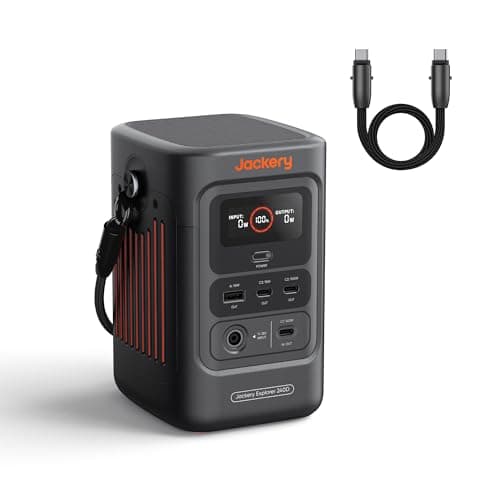
Jackery Explorer 240D Power Bank, 256Wh LiFePO4 Battery Portable Power Station, 200W DC Output, Charging Cable Included,1-Hour Fast Charging, Compact for Outdoor Camping, Travel, Emergencies
The Jackery Explorer Portable Power Station is designed as a versatile, battery-powered source of electricity — useful for camping, outdoor trips, emergency power outages, or off-grid scenarios. It offers a balance of portability and enough output/energy to power small electronics, charge devices, and run some low-power appliances. Its main appeal is flexibility: instead of fuel, it runs on stored battery energy, with multiple output ports for AC, DC, USB, and car-style DC devices.
Key Features
The Jackery Explorer Portable Power Station is designed as a versatile, battery-powered source of electricity — useful for camping, outdoor trips, emergency power outages, or off-grid scenarios. It offers a balance of portability and enough output/energy to power small electronics, charge devices, and run some low-power appliances. Its main appeal is flexibility: instead of fuel, it runs on stored battery energy, with multiple output ports for AC, DC, USB, and car-style DC devices.
Available Colors
Available Styles & Variants
Key Considerations
Battery capacity (Wh) vs. your usage needs: As with many portable stations in this size class, capacity limits mean it’s better suited for light-to-moderate loads (phones, laptops, lights, small appliances) rather than heavy, long-duration loads.
Output power and port types: You want to check which outputs (AC, USB, DC, car-port) are available — this determines what types of devices you can power (e.g. AC-powered appliances, USB-chargeable devices, 12 V devices from car port). Much of the utility comes from this versatility.
Portability & weight: A compact size and manageable weight make the station practical for camping, travel, or moving between rooms — but this inherently means compromise in total energy capacity compared with large power stations.
Battery type & longevity: Many smaller stations from this line use lithium-ion (or LiFePO₄ in some variants), with trade-offs between energy density, weight, cycle life, and cost. For frequent or long-term use, battery durability matters.
Realistic expectations of what devices/appliances you can power: Because of capacity and output constraints — a small power station can recharge phones, run laptops, lights, small fans — but may struggle (or be inappropriate) for heavy loads or long-duration appliance use.
Charge methods & recharge time: Depending on model and what accessories you have (e.g. solar panels, car charger, wall outlet), recharge speed and convenience matter for practical real-world use (camping, outages, travel).
The station’s stored energy (Wh) sets an upper limit on how long you can power devices — for light devices, that’s fine; but if you plan to run heavier loads or for extended time, you risk depleting battery quickly. Real-world usefulness depends on matching what you power with what the station can deliver.
These factors represent the most critical aspects that will impact your satisfaction with this product.
Customer Reviews
I’ve been using the Jackery Explorer 240 v2 for a while now and it has exceeded my expectations. Super lightweight and easy to carry, perfect for camping, outdoor events, and emergency backup at home. Charges quickly and holds power really well. I’ve used it to run lights, charge phones, cameras, and even a small fan with no issues. The display is super helpful and everything feels well-made and durable. If you’re looking for a dependable power station, this is it. Highly recommend!
Okay, I will start out by saying I am a U.S Service-member with over twenty years of Honorable service. With that being said I’ve done multiple tours to almost every desert in the Middle East, tours in tropical environments, tours in some pretty secluded off grid undisclosed locations.